Web & Mobile
← Projectsvocab
Internal testing on Google PlayA mobile vocabulary app for building and reviewing personal word collections.
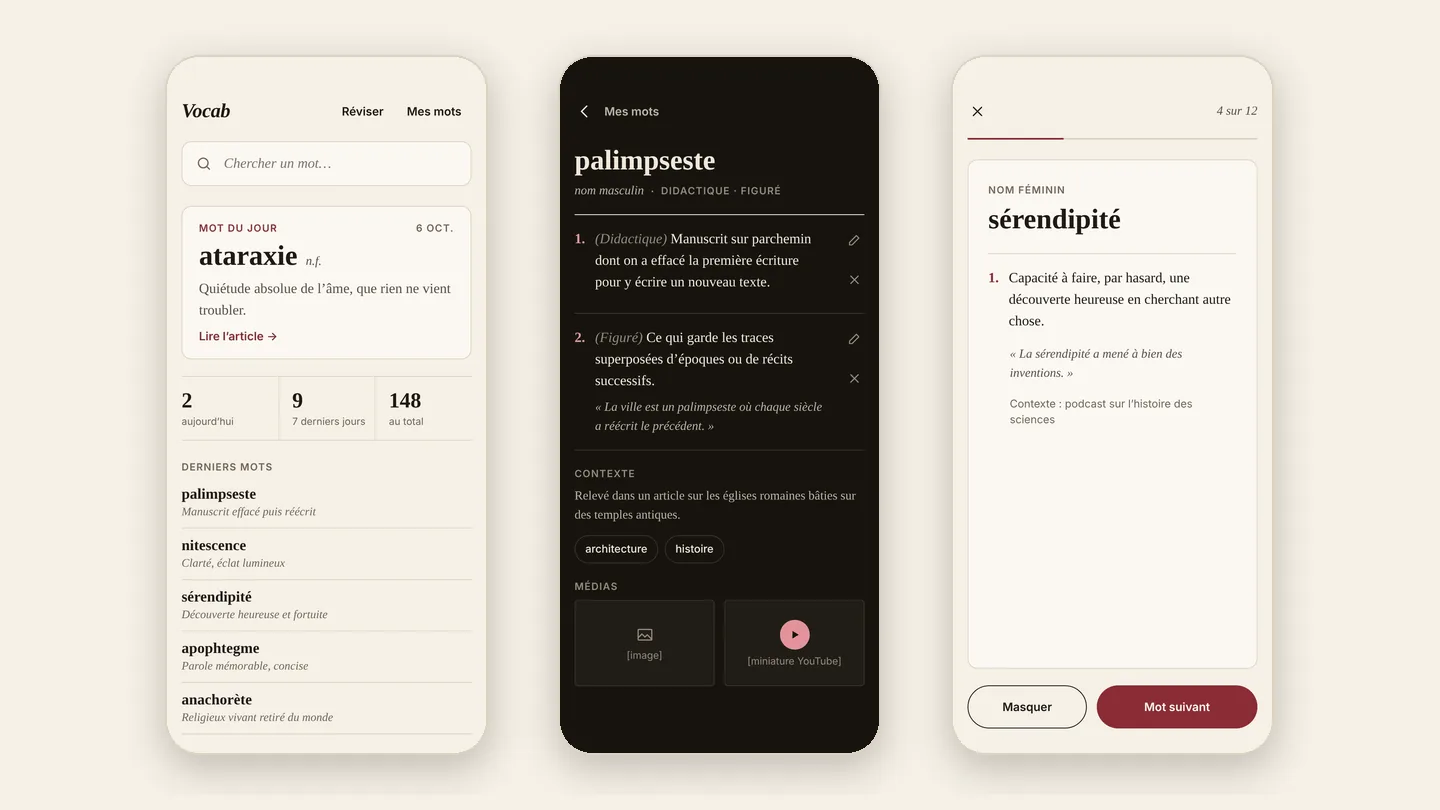
With vocab, I wanted to explore the full lifecycle of a mobile app, from design to deployment, on the development side as well as the DevOps side, while building a tool that is useful day to day: growing my vocabulary.
- Search for a word, with definitions coming from Wiktionnaire
- Pick the definition that matches the context where you came across it
- Save the word to your collection, stored on the phone
- Review your collection with flashcards
- Everything works offline, except search
Technical Architecture

DevOps
The app is compiled in the cloud by EAS Build: each build is signed, numbered automatically, then made available to testers on Google Play.
Continuous integration. Every push to the development branch goes through GitHub Actions: code analysis, type checking and unit tests.
A two-step release. A version tag triggers the build, but the upload to Google Play is started by hand. On a private repository, GitHub offers no approval before deployment without an Enterprise plan: the manual trigger plays that role of human sign-off.
Updates without going through the store. When only the JavaScript changes, the new version goes straight to the phones. The risk: shipping code that expects a native module missing from the installed app. To prevent it, a custom script compares the fingerprint of the native code with that of the last build and refuses to publish if they differ. A rollback command brings the app back to its original version if an update goes wrong.
Error tracking. Sentry reports crashes, keeping development and production apart. Each release is linked to the commits it contains and marked as deployed once it reaches testers: when a regression shows up, I know which version and which commit to look at.
The showcase site has its own pipeline: HTML validation, broken link checks and a performance audit with minimum thresholds. It is only deployed if everything passes, then checked in production.
Frontend
Built with React Native and Expo SDK 57, with file-based routing (expo-router) and a strict three-layer architecture:
- Service — fetches and parses definitions from an external API on each search
- SQLite (
expo-sqlite) — persists words and definitions locally once saved - Zustand — in-memory store bridging the database and the UI
Every screen is stateless by design. All the logic lives in custom hooks, so components focus on rendering.
Showcase Site
The site vocab.lionelpinheiroduarte.com is the entry point to the beta: visitors discover the app and sign up to join the test on Google Play. Sign-up goes through an email confirmation, then an invitation to the test.
Built With
- EAS Build, Submit + Update
- Cloud builds, Play Store uploads, and fingerprint-checked OTA JS updates
- GitHub Actions
- CI (lint/typecheck/test), a tag-triggered release pipeline, and site checks and deploys
- Sentry (
@sentry/react-native) - Crash and error reporting, releases linked to CI/CD for regression tracking
- React Native / Expo SDK 57
- Cross-platform mobile framework
- expo-router
- File-based navigation
- expo-sqlite
- Local SQLite storage (synchronous, offline-first)
- Zustand
- Lightweight global state management
- react-native-reanimated v4
- Gesture animations
- TypeScript (strict mode)
- Full type safety
- ESLint 9 (flat config, eslint-config-expo)
- Code quality
- Eleventy 3
- Static showcase site, hosted on o2switch
- PHP 8
- Double opt-in beta sign-up with HMAC-signed links